

Relic 02: Beckham's Predators
The most desirable boots in football

Science fiction
As a 14 year old I was absolutely obsessed with Adidas Predators. It was probably the first accessory I was aware of that acted as if it was something else, something greater than what it was for. My awareness of football boots up to that point had been fairly unremarkable. I knew that different brands made boots but they were generally just black leather with a different logo stitched on the side.
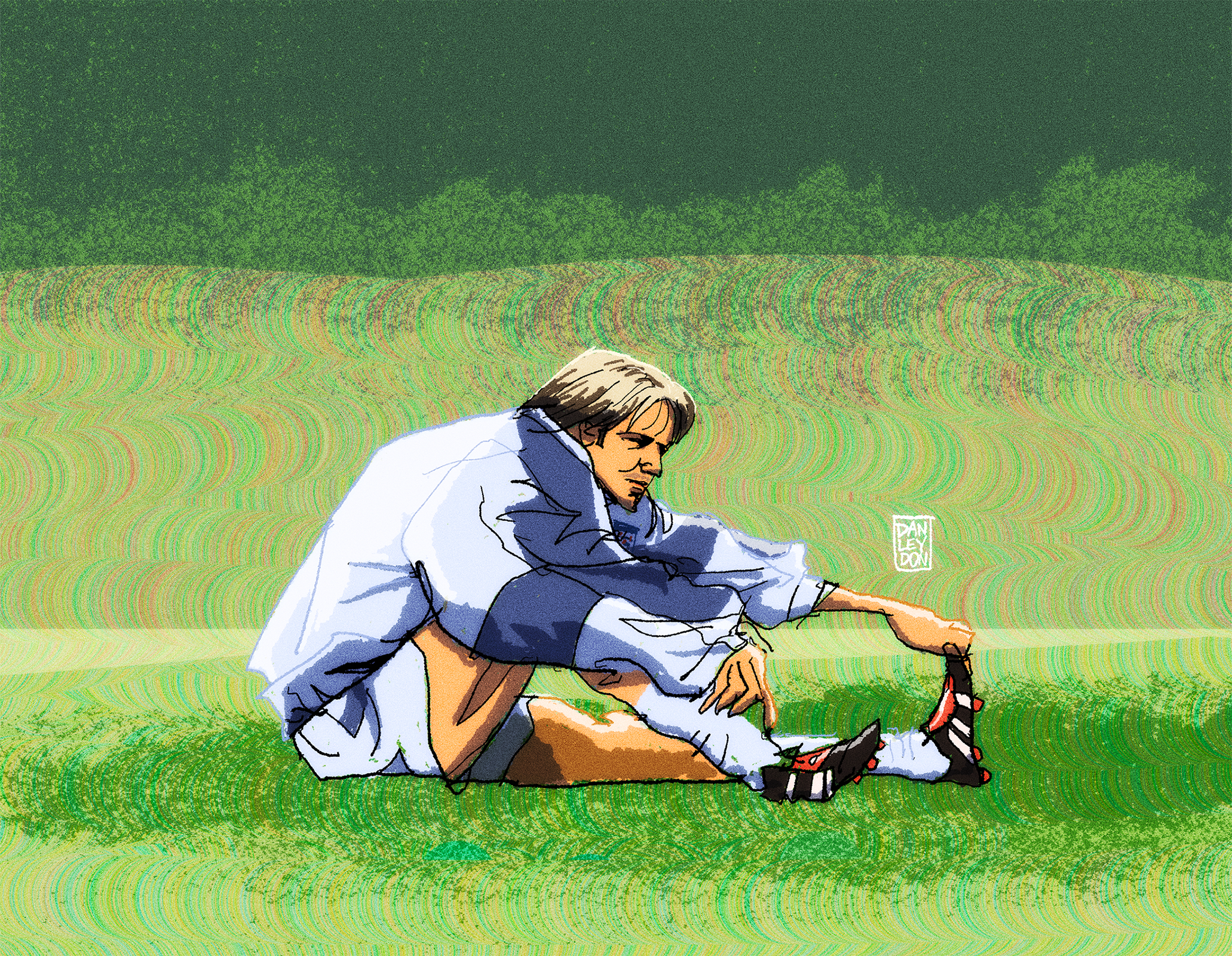
Predators capitalised massively on the trademarked innovation of a wide red tongue held down by elastic which looped under the boot. Much like Gillette introducing ever more bladed razors which claim to improve on the shave quality, this new flattened tongue allowed for a cleaner ball strike due to the uninterrupted contact area. I didn’t realise it but this was my introduction to product design which I would end up studying in college. These type of products which doubled as sporting accessory and cultural artefact really piqued my interest, they seemed to have more in common with science fiction than sport. A perfectly balanced blend of red and black with the three iconic white stripes, the boots were an instant classic. Although a strong point, the visuals were not the main attraction for a lot of purchasers. The most marketable aspect of the boots was the fact that David Beckham was wearing them whenever he whipped a free kick into the top corner.
Beckham
In all of football, from the first records to the current second you’re reading this, no one could strike a ball as well as David Beckham. What he did was twofold. The deliverable of the actual strike, the end product, was undeniable, he scored free kicks and placed crosses on foreheads at an astonishing rate, and he did it beautifully. The way he struck a ball, the stance, the run up, the sinewy approach to every stage of the process, they all combined to communicate one thing; craft. He could pass the ball ten feet and make it look like a complex execution.
If someone unfamiliar with the game watched Beckham and a standard player strike a ball, they would instantly know that Beckham was doing something to a higher level. Prowling like a panther in approach, as if sizing up the various curves of the ball so as to sniff out the most amenable one. Tilting and swerving as he made contact, physically living the trajectory he was sending the ball down, head bowed, arms cruciform, striking leg foreshortened so as to look scarcely believable.
In 1968 when Dick Fosbury won Olympic Gold his novel new way of approaching the high jump revolutionised the sport and the ‘Fosbury Flop’ was born. I’d argue that Beckham’s approach to striking a ball had a similar but smaller impact on football. I still remember the first time I was aware of who Beckham was; I was ten years old, a 1997 January FA Cup tie between Manchester United and Tottenham Hotspur was being shown live on TV and somehow in my Irish home it was available. I watched him send these looping crosses into the box all game and I marvelled at the way he hit them. When he scored a free kick in the second half my mind was blown. His execution seemed so technical yet so routine. I thought ‘why doesn’t he just do this EVERY TIME?’. It felt like the sport went up a level. I’d never seen anyone strike a ball with such panache.
A history of ball strikes
Periods in football history are defined by their photo quality, their footage quality and crucially how the players moved. In early days of black and white the players would run in extremely functional ways. Functionality enforced a strict regimen of movement. These were players who played as part of work teams, their main function was factory work and athleticism was only an extension of this. Their physical aims were housed in the factory; movement was a means to an end, all straight lines and distinct aims, lifting, moving, placing. I mentioned in my 1966 article that in the photos and footage of England winning the World Cup you can see at a glance that people don’t move like that anymore. Styles of movement come and go, just like singing. Placing footage of Beckham striking a ball beside footage of a player from 1960 you’d think they were playing two different sports. His run up contained the previous 60 years of football, so many layers of thought and trend, like sediment that had settled over the decades. Body language was now much more than functional; it was part of a high performance execution, a disguise to fool the opposition, an enhancement of the player brand.
The technology of the sport is always in constant conversation with the execution of the sport. Beckham didn’t hit a ball like that because he wanted to, he did it because that was the smartest way to approach the ball that was being used. In 1960 players wore work boots and generally seemed to strike heavy footballs from behind with a rising leg, hitting with the toe. Beckham would wrap his momentum around the ball to produce the whip effect, the momentum and direction coming from the instep. As he made contact his body would noticeably veer quickly from leaning back on his left leg to almost falling over on his right. This lateral movement showed how he was hitting across as opposed to through the ball, a specific technique that resulted in the ball curling inwards and seemingly picking up speed as it flew through the air. This was his trademark and the most iconic part, the right foot that struck the ball, was draped in red and black Adidas livery. It promised some smaller fraction of his output, a new skill tethered somehow to these leather shoes.

Mystique
Beckham is the most self-aware player in football history and set the template for how modern players manage their image rights. He always knew his exact worth and held it in the back of his head. He leveraged his image, his skill, his looks, his lack of a distinct or strong personality, which was obviously by design; an empty vessel is the perfect container for advertising aims. These elements of his personality must have combined to amplify the drama of his ball strike. Even though he just runs up and kicks the ball without any particular preamble like dropping grass on the breeze or blessing himself, he gives a performance laden with effort in that few seconds.
Beckham’s greatest moment was his 93rd minute free kick against Greece to drag England to last minute World Cup qualification. That moment, from preamble to strike to iconic celebratory leap into the air, was probably the biggest moment in recent English sporting history, and it came from a foot draped in a lily-white Adidas Predator, which by then was shorthand for the man. This ball striking super power was the mechanism that Adidas used to elevate the Predators away from every other boot that went before them. They became an icon, because of David Beckham. His magic, a movie-star athlete, gave them their mystique. As a gullible fourteen year old, I gobbled it up.
Mud odyssey
My school Gaelic football team trained in a field. It was a ten minute walk away, up a one-lane road with grass growing in the middle. I walked that distance in my new Predators, eager to see how many top corner goals I’d score. This new, flat red tongue would no doubt prove a massive difference in my fledgling sporting career.
At the pitch one set of goals was positioned on a small hill so it felt like that goal line would be at about the same level as the opposite crossbar. The Ox mountains ran alongside, looming on the horizon like a grey tsunami held in intimidating stasis. I can’t remember many top corner goals that day, which probably means there were none. With the last kick of training, maybe thanks to tongue innovation, I sliced a pass or a shot over the endless verge of thorn bushes that provided a boundary between our pitch and the neighbouring field. My trainer jerked his thumb and off I had to go to retrieve the ball.
The next field was home to a herd of cows and their hooves, combined with the constant rain, had churned the solid earth into a type of brown, quicksand lasagne. I stood on the metal gate, one leg either side looking for the white ball. Hopefully it was near - it wasn’t. About one hundred metres away it sat, pristine like a distant egg, it’s bottom third suctioned in mud. With the trainer watching me I knew I had to trudge to that ball. There was no other option than to hop in. It went up past my ankles, cold.
The mud never left the creases, it never left the plastic fuzz of the velcro, it never left the white stitching of the logo. Between the hyper designed Adidas Predator and the mud, mud won, hands down. As I waded out of the field holding the ball I looked at my newly brown predators. The glamour of whipping a free kick into the top corner was very far away. Mud was real. On that ten minute odyssey through the slop I was forced to abandon any care of my newly purchased fashion statements. Every ounce of mystique and splendour they had was drowned in the shin deep slime. The part of me that wanted to own these things, just to have them near me, withered. I still appreciated what they were and how they became what they were but the need to have them, that disappeared. The thought that they would help me be better at the sport was now laughable. I handed the ball to my trainer, feeling my socks soak in the freezing cold liquid invading every crevice around my shrivelling feet. A cow took me in, black eyes like twin marbles, and went back to chewing the grass, bored of looking at the young boy in mismatched training gear, brown from the shins down.
Also from this series…
